If you've invested in a website, hired someone to manage your social media, and optimised your Google Business Profile, you might think you've covered all your marketing bases. But here's the thing: you're only seeing half the picture.
Yes, digital marketing dominates the conversation. Every business blog, every marketing agency, every consultant seems to insist that if your strategy isn't online-first, you're already behind. But talk to a successful local plumber, a thriving high street café, or a booked-out physiotherapy clinic, and you'll hear a different story. They're not just winning online—they're winning because they understand something that's been forgotten in the rush to go digital: traditional marketing still works.
The truth isn't that online marketing has replaced offline tactics. It's that most businesses are trying to use one without the other. And that's costing them money, customers, and growth.
What Is Traditional Marketing Today?
Before we go further, let's be clear about what we mean by traditional marketing in 2025. It's not about cramming newspaper ads or waiting for Yellow Pages directories. Traditional marketing is any strategy that reaches people offline—and it's evolved significantly.
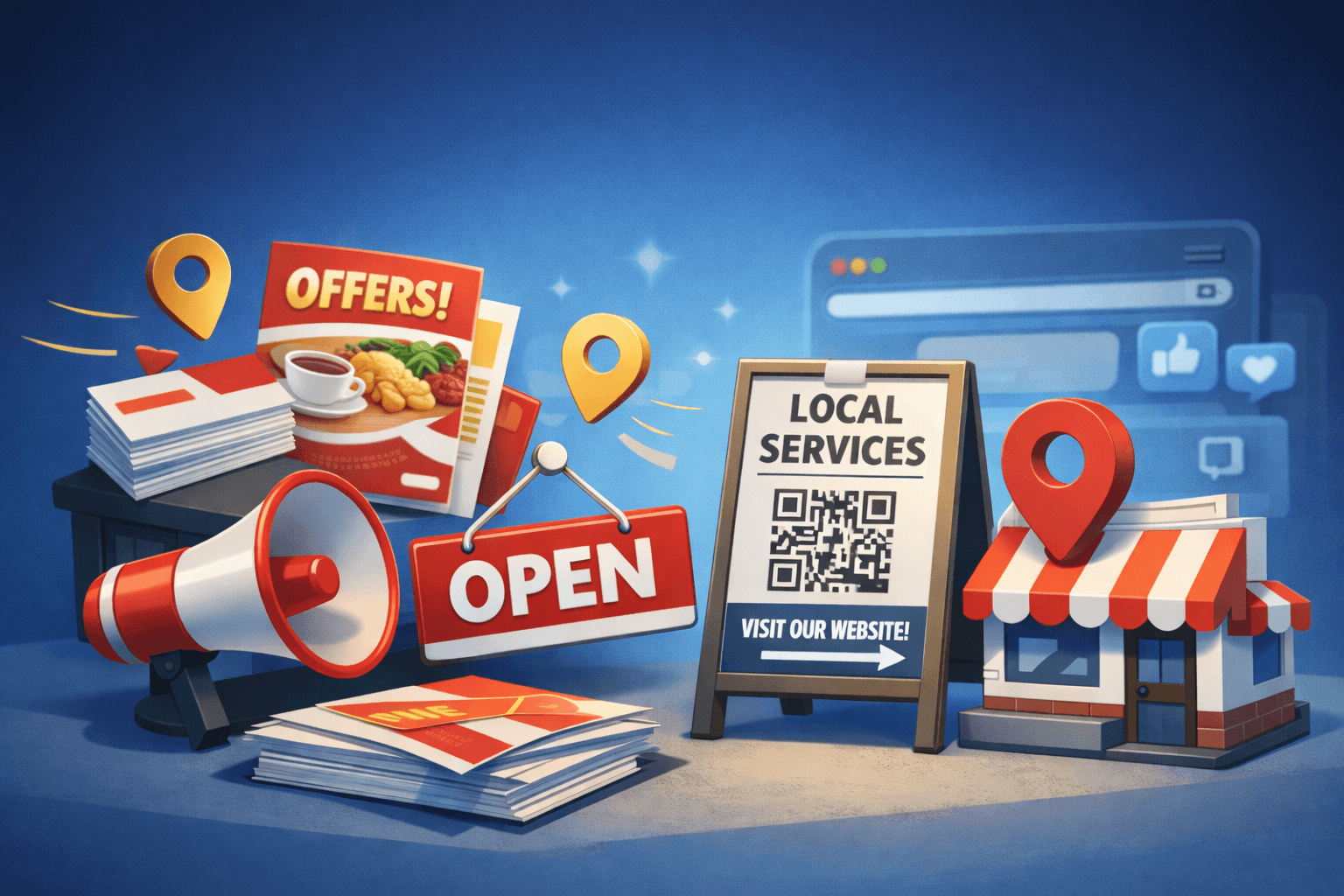
It includes the basics you might already be using: business cards handed out at networking events, leaflets popped through doors or displayed in local spots, vehicle branding on your van or car, and in-person outreach at community events or through door-to-door conversations. It also covers shop signage, window displays, sponsorship of local teams or events, and even good old-fashioned word-of-mouth marketing, which remains one of the most powerful tools available.
These methods haven't disappeared from the marketing toolkit—they've simply been overshadowed. But they've also become more valuable in certain contexts precisely because so many businesses have abandoned them. When everyone's fighting for attention on Instagram and Google, a well-designed business card or a professional leaflet actually stands out.
Why Traditional Marketing Still Works
Here's what digital marketing can't always replicate: tangibility. When someone holds a well-designed business card in their hand, it creates a physical connection to your brand. They can put it on their desk, pop it in their wallet, or leave it on the fridge. It's a lasting reminder of your business—not a notification that scrolls past in seconds.
Traditional marketing also builds trust in a different way. Local trades, in particular, understand this instinctively. A homeowner who receives a professional-looking leaflet from a qualified electrician is more likely to trust that business than one that only exists as a social media profile. It signals investment, professionalism, and permanence. You've gone to the effort of printing something, getting it in front of them—that matters psychologically.
There's also something about face-to-face interaction or locally distributed materials that digital channels struggle to replicate. A regular customer of a local café remembers it partly because they've walked past the shop window a hundred times, partly because the owner chatted with them, and partly because someone they know recommended it. That mix of offline touchpoints builds community and loyalty in ways a targeted Facebook ad simply cannot.
And let's be practical: not everyone is digital-first. Your target customer base might be. But across the UK, particularly outside major cities, there's still a significant portion of the population that prefers to discover services locally, by recommendation, or through printed materials they see around their community. Ignoring them means ignoring revenue.
How Traditional and Digital Marketing Work Best Together
This is where things get interesting. The real power isn't in choosing between traditional or digital—it's in connecting them strategically.
A leaflet with a QR code that takes customers directly to your Google Business Profile, booking page, or Instagram means you're capturing someone at the moment they're ready to engage. A business card with your website, phone number, and social media handles ensures every offline conversation can continue online. Vehicle branding creates awareness in your local area—and when someone sees your van regularly, they're far more likely to Google your name or look you up on Facebook when they need your service.
Professional signage reinforces your brand identity in the same way your website does. When the colours, fonts, and messaging are consistent between your shop window, your leaflets, your website, and your social media, customers see a cohesive, trustworthy business. That consistency is a competitive advantage.
Real-World Example
A local gym in Manchester launches a new membership drive. They create professional flyers with their updated branding, a QR code linked to their membership pricing page, and a call-to-action encouraging people to visit their Instagram for transformation stories. The leaflets are distributed to homes within a two-mile radius. The same week, they post the campaign on social media and tag their location.
A prospect picks up the flyer from their letterbox, scans the QR code to learn more, follows the Instagram, sees the testimonials—and books a consultation. That customer discovered the gym offline but converted online, with every touchpoint reinforcing the same message. This isn't coincidence; it's the result of strategic integration.
Mistakes Businesses Make With Traditional Marketing
So why do so many small businesses still feel like traditional marketing isn't worth the investment?
Often, it's because they've done it badly. A poorly printed leaflet with outdated branding, a business card that doesn't match your website design, or signage with inconsistent messaging sends the opposite signal: that your business is unprofessional or doesn't care about details. These materials represent your business to people in their community—they need to look the part.
Another common mistake is having no clear call-to-action. A flyer that simply tells people you exist without saying what to do next is wasted paper. "Visit us online," "Call for a free quote," "Follow us on Instagram"—these phrases matter. They guide the customer to the next step.
The biggest mistake, though, is treating traditional marketing as separate from your digital strategy. A leaflet pushed through a door that doesn't mention your website, QR code, or social media channels is doing only half its job. Conversely, a website that doesn't mention your physical location, shop hours, or local community involvement is missing an opportunity to feel locally rooted.
And finally, many businesses undervalue traditional marketing simply because it's not new or trendy. They treat it as the strategy of last resort rather than a legitimate, measurable part of a balanced marketing mix. As a result, they don't invest in professional design or distribution—and then they're surprised when it doesn't work.
The Balanced Approach to Marketing Growth
The businesses that are growing fastest in 2025 aren't choosing between traditional and digital. They're using both, intentionally and strategically.
They're investing in professional branding that works everywhere—on their website, across social media, on business cards, on their van, and in print materials. They're thinking about their customer's entire journey: where might they discover me? How will they remember me? What will convince them to choose me over a competitor? Often, the answer involves multiple touchpoints, both offline and online.
Three Actionable Takeaways You Can Implement This Week
1. Audit Your Offline Materials
Do your business cards, leaflets, and signage match your website and brand identity? If not, they're working against you. Inconsistent branding across offline materials suggests a lack of professionalism and strategic thinking. Invest in professional, consistent design across all materials. This unified approach signals that you're a serious, cohesive business.
2. Add Digital Connections to Every Offline Touchpoint
Your leaflets should include your website, a QR code, or a specific call-to-action that drives people online. Your business card should list your social media handles. Your signage should mention your Google Business Profile. Make it easy for people to continue the conversation digitally. The gap between discovery and action should be as small as possible.
3. Measure and Refine
Use unique discount codes, phone numbers, or QR codes on different materials to track which offline efforts are driving online conversions. This data will tell you where to invest more and where to adjust. Traditional marketing doesn't have to be vague—modern tracking tools let you measure ROI just as precisely as any digital campaign.
The Opportunity Is Yours
In a world obsessed with algorithms, SEO rankings, and social media metrics, it's easy to dismiss traditional marketing as obsolete. But the businesses that are thriving locally—the ones with loyal customers, steady referrals, and sustainable growth—understand the complete picture.
Traditional marketing isn't dead. It's not even dying. It's just been sidelined by the noise around digital transformation. The opportunity is yours if you're willing to see it: in a marketplace where most of your competitors are fighting for attention online, you can build real, lasting presence by combining physical and digital tactics strategically.
Your customers don't think in silos of "online" and "offline." They experience your brand holistically—a leaflet that catches their eye, a conversation with a friend, a scroll through your Instagram, a visit to your website, a call to discuss their needs. Each touchpoint shapes their decision. The businesses winning are the ones who understand this and design their marketing accordingly.
Ready to Build a Cohesive Marketing Strategy That Actually Works?
Understanding that traditional and digital marketing work best together is one thing. Executing a unified strategy across both channels is another.
At Webula, we help local businesses, trades, clinics, and service providers build integrated marketing strategies that work across both worlds. From brand identity and website design to leaflet campaigns, signage strategy, and digital marketing, we believe the best results come from a cohesive, integrated approach. We don't see traditional and digital as opposing forces—we see them as a unified toolkit for growth.
We specialise in helping businesses like yours reach customers at every touchpoint—whether that's a professionally designed leaflet, a cohesive brand identity, or a high-converting website—and making sure every element works together to drive real business growth.
Ready to stop leaving revenue on the table by choosing between online and offline marketing? Book a consultation through our contact form — no obligation. Let's discuss how we can transform your marketing approach to leverage both traditional and digital tactics for sustainable growth.